THE BATTLES OF KUHMO 30 NOVEMBER 1939 – 27 JANUARY 1940
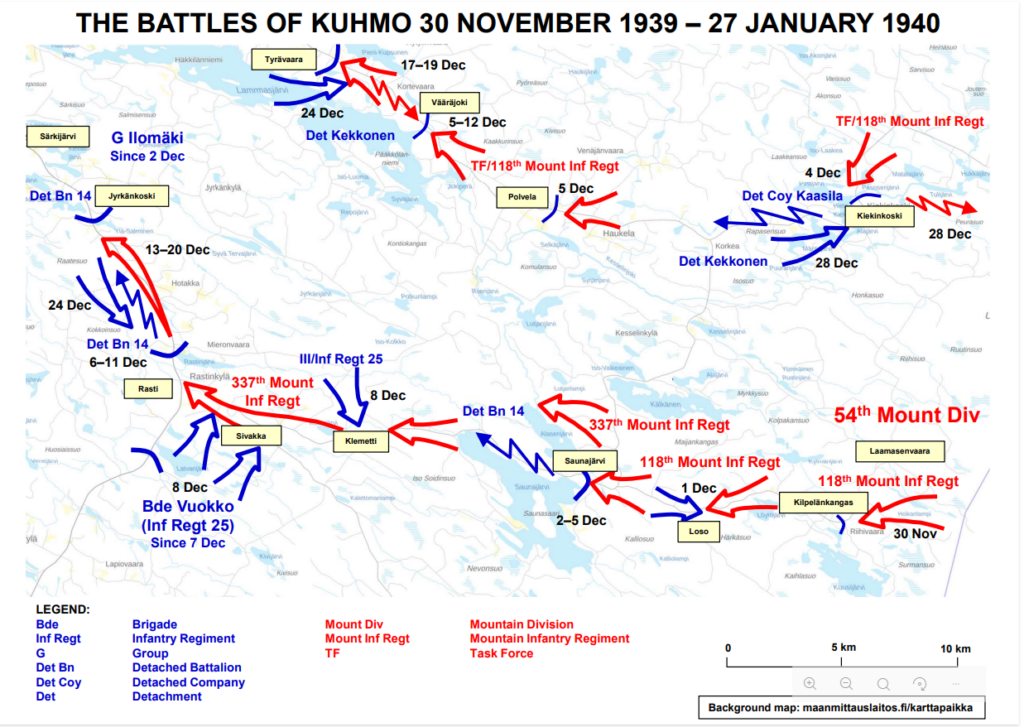
During the additional reserve exercises, Detached Battalion 14 (Det Bn 14) and Detached Company Kaasila (Det Coy Kaasila) had been mobilized at the Kuhmo Exercise Centre (KuhEC). In the early stages, the troops in the Kuhmo sector were under the command of the North Karelia Group. It was assumed that only weak Soviet troops would oppose them, and the plan was to take the war to the Soviet side of the border. However, the offensive operation turned into a delaying phase, which lasted about a week. The first battles were fought near the border, at Laamasenvaara and Kilpelänkangas, on 30 November. On 1 December, the Finns set off to carry out the ordered offensive mission in the direction of the Saunajärventie Road, but the attack was halted at Loso. They were facing the enemy’s 54thMountain Division (54th Mount Div).
The next day, the Kuhmo sector was detached and placed directly under the command of the North Finland Group. The troops in Kuhmo were formed into Group Ilomäki (G Ilomäki). Defensive battles were fought at the Saunajärvi defensive position on 2–5 December. Detached Battalion 14 repelled the attacks in the defensive position, but the flanking manoeuvre by the enemy’s 337th Mountain Infantry Regiment (337th Mount Inf Regt) from the north side of Lake Alasenjärvi forced the Finnish troops to retreat westwards on the evening of 5 December. Detached Battalion 14 regrouped in the Rasti area the following day. The situation was difficult, but Brigade Vuokko (Bde Vuokko), which had been detached from the Finnish Headquarters’ reserve, was moving to the Kuhmo area at the same time.
In the next phase, the Finns managed to stabilise the situation. A counterattack was launched by Brigade Vuokko in the Rasti sector on 8 December. The attack did not achieve its objectives, but it was a surprise and inflicted casualties on the enemy. In addition, Brigade Vuokko formed a threat to the flank of the enemy’s 54th Mountain Division. Detached Battalion 14 was forced to abandon the Rasti defensive position on 11 December, but the advance of the enemy’s 54th Mountain Division was halted in the battles fought at the Jyrkänkoski defensive position on 13–20 December.
The enemy’s Task Force of the 118th Mountain Infantry Regiment (TF/118th Mount Inf Regt) attacked on the northern flank, in the Kiekinkoski sector. Detached Company Kaasila was forced to withdraw from Kiekinkoski on 4 December. In order to stop the enemy, Detachment Kekkonen (Det Kekkonen) was formed from two companies at Vääräjoki on 5 December. This unit succeeded in halting the enemy at Tyrävaara starting on 17 December. Lieutenant Jussi Kekkonen, the commander of the detachment, was the younger brother of President Urho Kekkonen. On Christmas Eve, he launched a counterattack, which was made in connection with an attack in the Rasti sector. On 28 December, the attack of Detachment Kekkonen led to the destruction of an enemy battlegroup at Kiekinkoski. The enemy had now been pushed back behind the border, and the northern flank of the 54th Mountain Division was open.
After this, the fighting subsided and the next phase took on the character of trench warfare for almost a month. The calmer period at the front in Kuhmo was probably also influenced by the events at Suomussalmi and Raate Road (Raatteentie). The difficulties the Red Army experienced there possibly led to passivity in Kuhmo as well. However, this stationary phase of the war included patrol battles and attacks by guerilla troops, as well as other smaller engagements.
THE BATTLES OF KUHMO 28 JANUARY – 13 MARCH 1940
The next phase of the fighting can be described as a major counterattack. The 9th Division (9th Div) led by Colonel Siilasvuo had achieved a major victory on Raate Road (Raatteentie) on 7 January 1940. After this, the command of the North Finland Group decided that the division would be directed to defeat the enemy advancing in Kuhmo.
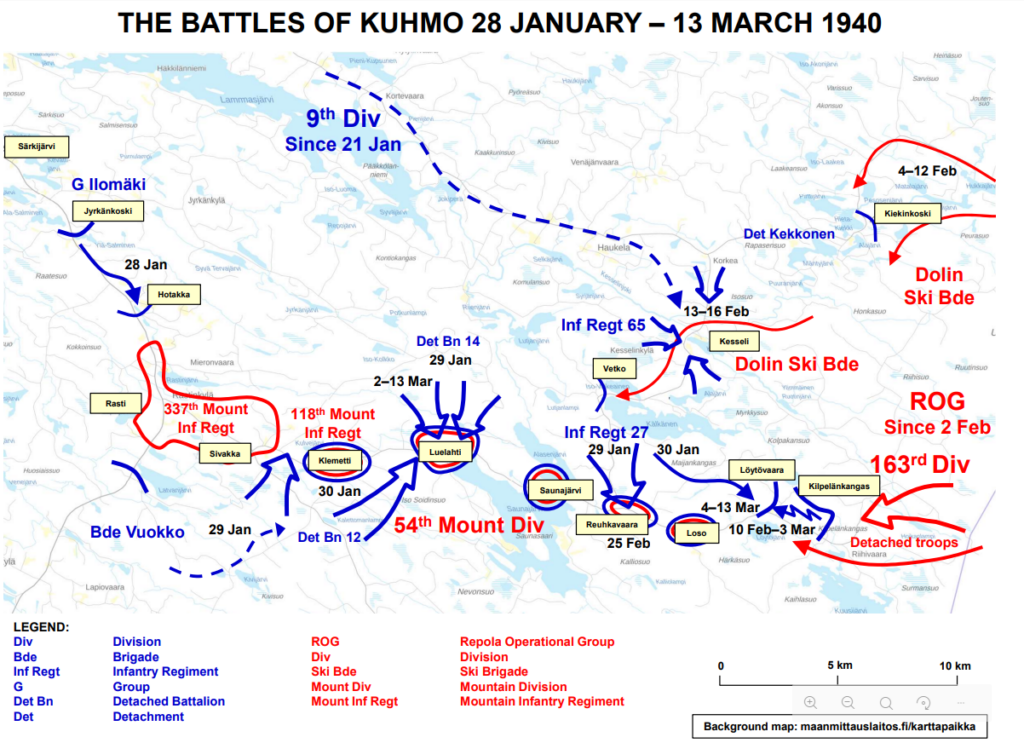
Preparations started after mid-January with the aim of attaching all the troops in the Kuhmo sector under the 9th Division Commander, Colonel Siilasvuo. The commander of the North Finland Group, Major General Tuompo, gave the order to attack the Saunajärvi area from the north and then prepare to continue the attack westwards. However, Siilasvuo decided to extend the mission eastwards, towards Löytövaara. This proved fatal, as the attacking Finnish troops spread out too widely.
The enemy’s 54th Mountain Division (54th Mount Div) was successfully split into smaller parts, but the resulting encirclements (mottis) could not be completely destroyed. The last month and a half of the war turned into fierce motti battles. Of the formed mottis, the Reuhkavaara motti was successfully destroyed on 25 February and two parts of the Luelahti triple motti were wiped out between 2 and 8 March. At the same time, the Finns repelled the attacks launched by the Repola Operational Group in fierce defensive battles at Kilpelänkangas.
The battle against the Red Army’s ski troops in mid-February had its own special characteristics. The most notable engagement was the destruction of the Dolin Ski Brigade (Dolin Ski Bde) in the Vetko–Kesseli area between 13 and 16 February 1940. The main reasons for the destruction of the brigade, which numbered around 1,800 soldiers, were the fall of its commander, Colonel Dolin, on 12 February and the severe frost period that affected the battle.
At the end of February, troops from the Soviet 163rd Division (163rd Div) were transferred from Suomussalmi to Kuhmo and placed under the command of the Repola Operational Group. The enemy managed to break through the Kilpelänkangas defensive position on 3 March, which forced the Finnish troops to retreat to Löytövaara. The troops fighting in Kuhmo were unaware of the ongoing peace negotiation. An attack to destroy the western motti at Luelahti was launched on the evening of 12 March, but it was unsuccessful. The arrival of peace at 11 a.m. on 13 March saved the troops of the 54th Mountain Division in the mottis, and the Finns were unable to achieve a major victory in the form of war booty. On the other hand, the arrival of peace also saved the Finnish troops at the Löytövaara firestorm. In any case, the 54th Mountain Division had been defeated and the Dolin Ski Brigade had been destroyed.
The peace also arrived at the right time in regard to the whole of Northern Finland. A new offensive by the Soviet forces was likely to start with four new divisions on 22 March 1940.
